Breaking the Mold: Takuro Kuwata
*
Breaking the Mold: Takuro Kuwata *
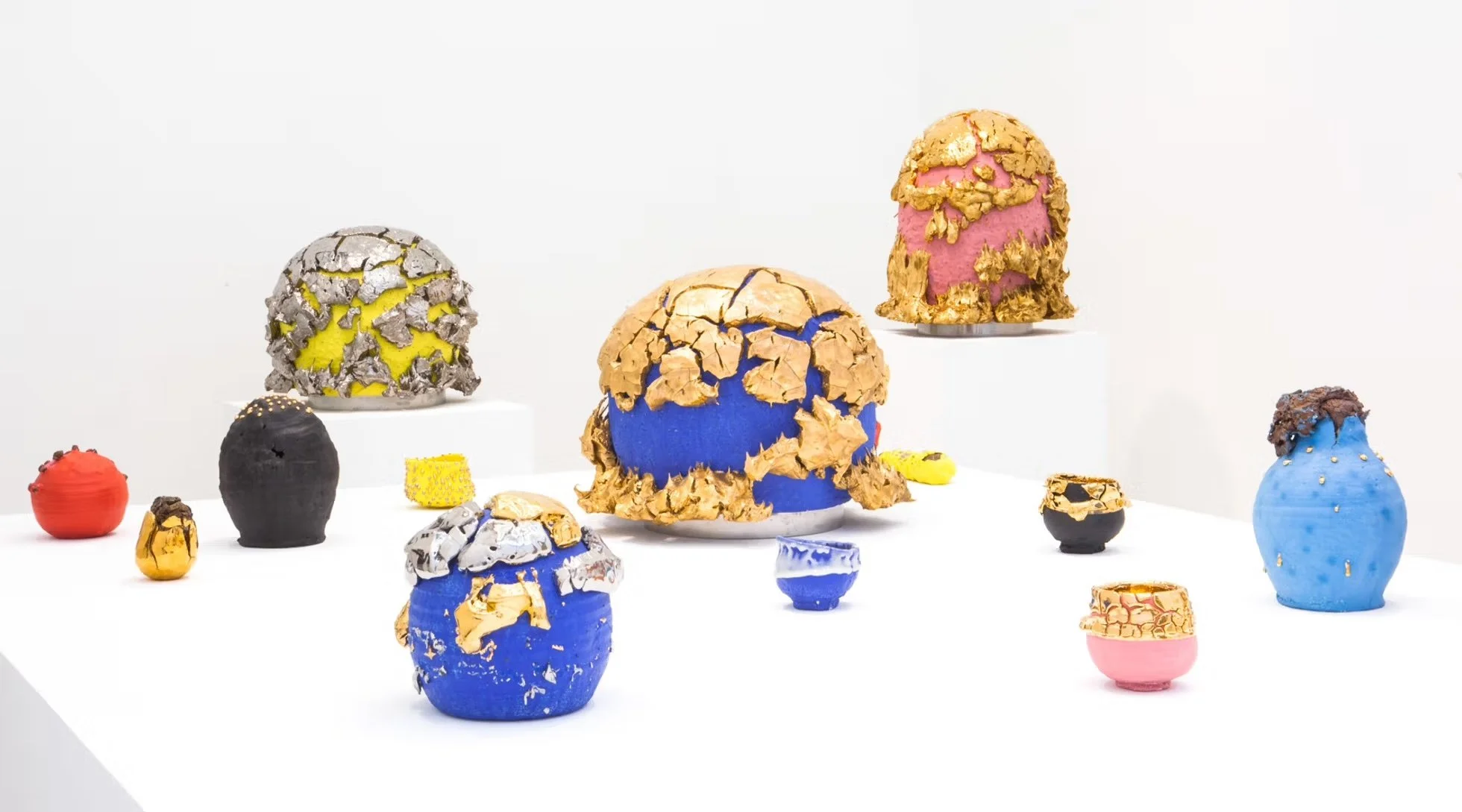
Takuro Kuwata’s gem-studded vessels, in vivid Pop Art reds and blues, appear far removed from traditional Japanese tea ceremony ware. Similarly, the artist’s sherbet-hued bowls — malleable-looking structures with cracked, milk-white armors of glaze — could only be surreal, even psychedelic renderings of tea ceremony ceramics.
But Kuwata, a young Japanese artist whose first solo exhibition in the United States, “Flavor of Nature,” opens Friday at Salon94 Bowery, insists that his work is in dialogue with the centuries-old ritual. “The tea ceremony bowl has both a specific function and a more abstract aesthetic,” Kuwata said. “My work, I think, shares this dual sensitivity.”
After an apprenticeship with the master artist Susumu Zaima, Kuwata began to experiment with traditional methods, expanding the formal possibilities of his craft to develop a distinctive style that seems to straddle the distant past and the imagined future.
“Yellow green-slipped gold-drop bowl,” 2012, in which beads of gold glaze appear to be “condensing” on the pot’s exterior.
Using Kairagi-Shino, a method of firing in which pottery is removed from the kiln before the glaze completely melts, Kuwata coaxes his pieces to appear as if they are exploding from within, like otherworldly crustaceans shedding their shells. Ishihaze — or “stone explosion” — allows Kuwata to create the dazzling bursts of petrol, gold and mercury that dapple many of his pieces and lend another layer of textural complexity.
The colors of a Kuwata piece — saturated, vibrant and often shocking — immediately arrest the viewer’s eye, making it exceedingly difficult to look away.
Critics have described Kuwata’s recent works as “dysfunctional” objects. Indeed, the vessels seem to shirk their associated conventional uses. Kuwata, however, considers both form and function fundamental to his process. “Function is at the core of each piece,” he said. “In dealing with the materials to achieve this end, form emerges.”
Kuwata does not see his work as rebelling against the norms of his medium. “I’m not trying to break the rules,” he said. “I just want to apply a contemporary sensibility to pottery. I believe I can create something truly new, work that reflects our time.”
“Flavor of Nature” will be at Salon94 Bowery through Feb. 25.
Read the story in The New York Times.
David Hockney Paints Yosemite — on an iPad
*
David Hockney Paints Yosemite — on an iPad *
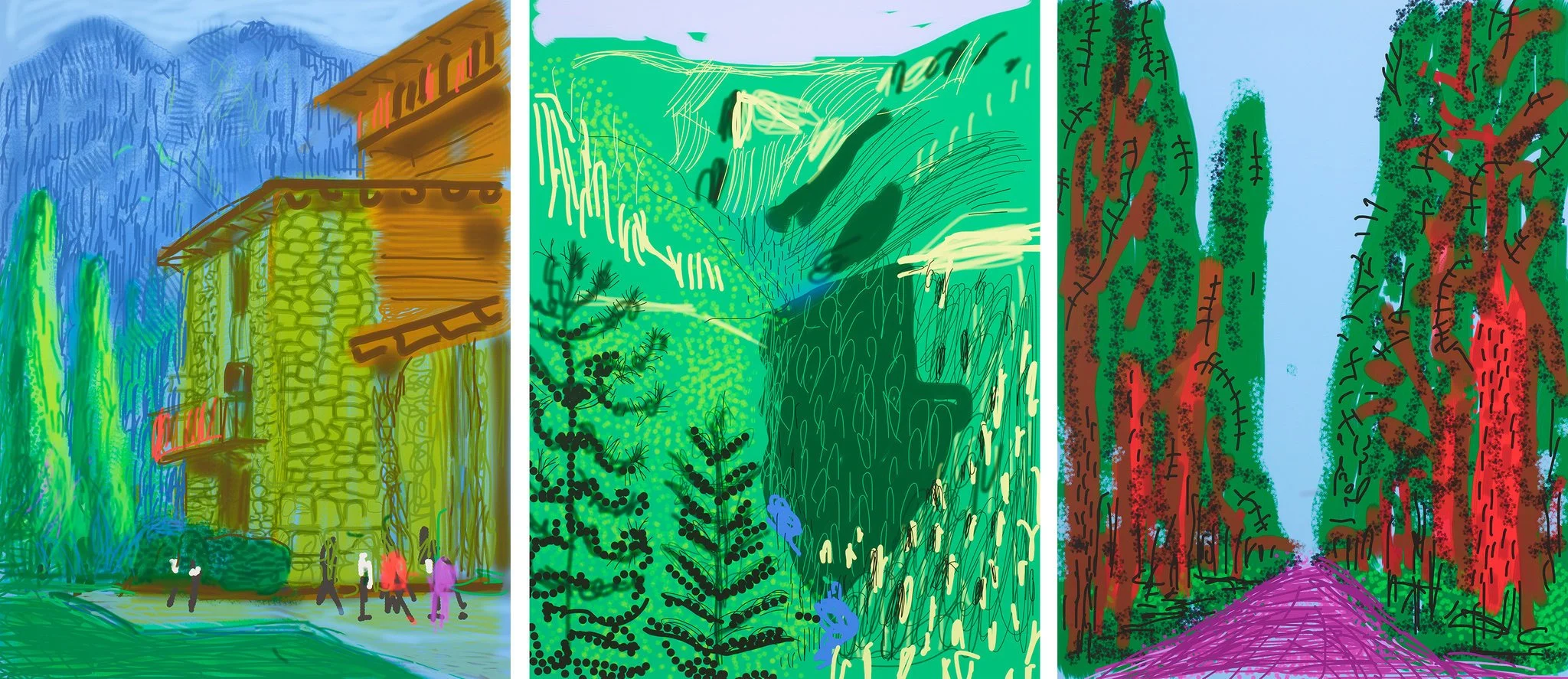
The American West has captivated David Hockney for decades. The 78-year-old painter, printmaker and photographer has depicted the West in diverse forms, from sun-splashed swimming pools and portraits from 1960s and ’70s Los Angeles, to a sprawling, 60-canvas oil painting of the Grand Canyon. Hockney, who maintains a studio and home in the Hollywood Hills, continues to experiment with new media — from photocopiers and fax machines to the iPhone app Brushes and digital films. And a new exhibition at Pace Gallery presents “The Yosemite Suite,” a group of more than 20 works that Hockney made on his iPad during visits to Northern California’s Yosemite National Park in 2010 and 2011.
Drawing the landscapes as he experienced them, the artist relished the immediacy of the iPad as a tool. “You can set up a palette very, very quickly indeed — quicker than any other medium,” Hockney says. “It’s also an endless sheet of paper, and the color is literally at your fingertip.” The result is a series of vibrant, textural drawings, which the artist reproduced as large-format prints, meticulously transposed according to a scale that he feels captures Yosemite’s splendor.
The series includes iconic vistas and landmarks, as well as intimate glimpses into Hockney’s excursions into the landscape itself. In “Untitled No. 1” (above left), the blue shadow of a mountain looms behind a stone facade, with the bright abstractions of tourists occupying the foreground. In “Untitled No. 2” (right) a redwood-lined road stretches, with no apparent endpoint — a meditative view of a traveler’s solitary journey through nature. Hockney’s bird’s-eye view gazes down upon the Yosemite Valley in “Untitled No. 21” (center), a dizzying perspective that includes coniferous trees and dense forests, as well as the sharp, purposeful lines of Half Dome’s granite face in the distance. It’s clear that the views are entirely Hockney’s own, rather than exact reproductions. “They are drawn landscapes,” Hockey explains. “Photographs are very theatrical — they need lighting. My eyes can see more.”
Others in the series play with light (a spidery sun glints through tall trees, their shadows long and purple on the forest floor) and movement, both man-made and natural. In “Untitled No. 13,” a waterfall streams down a green wash of mountain that recalls a watercolor painting, while kinetic lines swirl at the base — perhaps evidence of the sketched figures and their cars parked nearby.
With “The Yosemite Suite,” Hockney joins a host of artists who have been captivated by the park’s allure since its founding in 1890. Before Ansel Adams’s lens, the painter Albert Bierstadt’s dramatic landscapes gained important early publicity for Yosemite, and drew the first crowds from around the United States in the late 19th century. Now, as the National Park Service celebrates its centennial, the presentation at Pace seems to echo the tradition of landscape artists as champions of wild spaces. The coming year is also significant for Hockney: An exhibition of recent work from his Los Angeles studio opens in July at the Royal Academy, London, and a traveling retrospective at the Tate Britain, the Centre Pompidou and the Metropolitan Museum of Art begins in February.
Hockney’s eye for subtle details and temporal changes in the environments he captures continues to influence the way we see the world around us. “I think landscape is a spatial thrill,” he says.
“The Yosemite Suite” is on view through June 18 at Pace Gallery, 537 West 24th Street, New York.
Read the story in The New York Times.